Tampa Bay homeowner guide
Demand + ownership worksheetTank vs. tankless water heaters: what Florida homeowners should compare
There is no universal winner. Compare your household's peak hot-water demand, existing fuel and electrical setup, installation constraints, maintenance expectations, and the complete installed scope—not only a headline efficiency or equipment price.
On this page
The short answer
What to do first
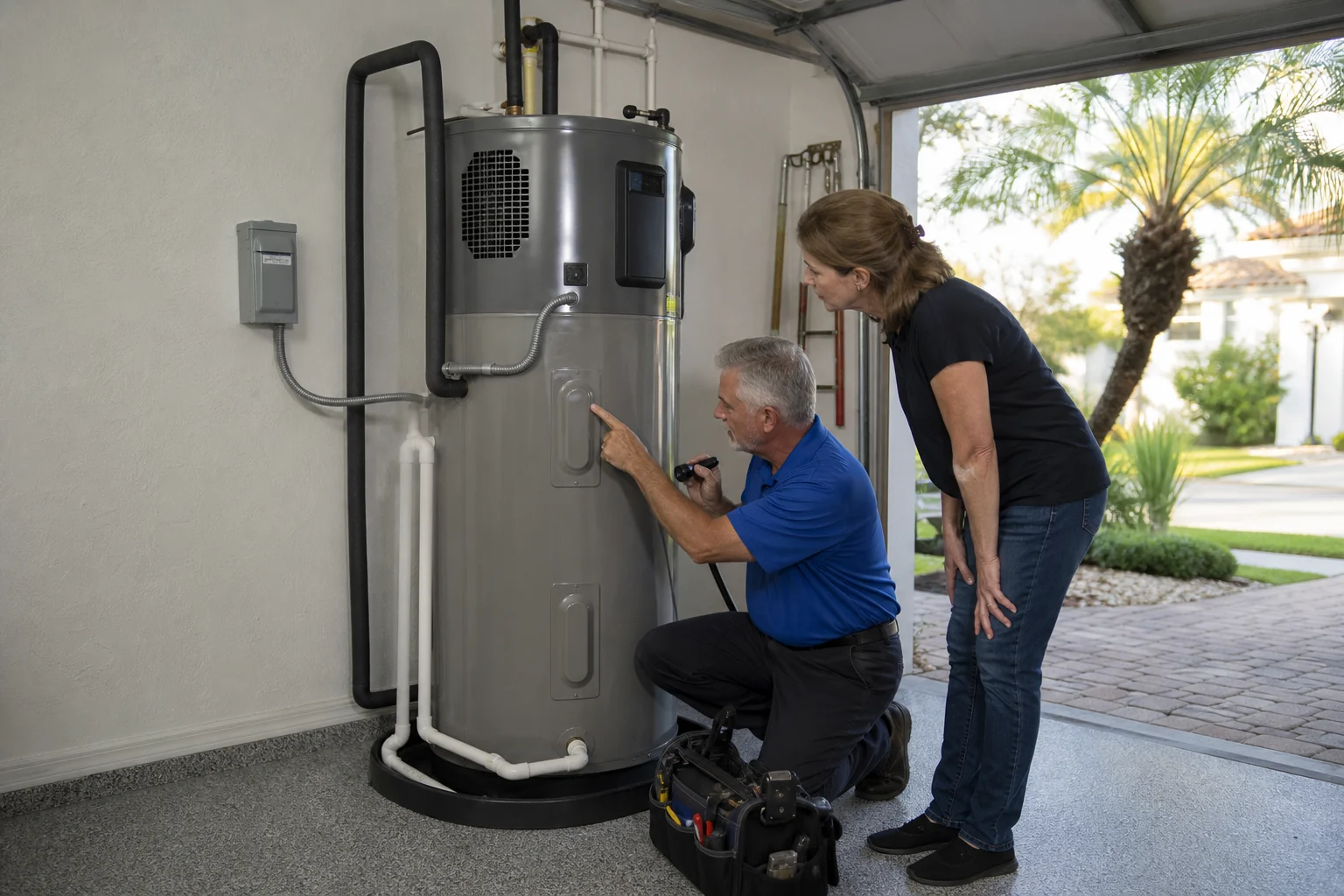
Neither tank nor tankless is automatically best for a Florida home. Compare peak simultaneous demand, recovery or flow, incoming-water conditions, energy source and capacity, space and venting, electrical or gas upgrades, condensate/drainage, maintenance, outage behavior, installed cost, warranty, and the household's tolerance for operational limits.
Five things to remember
- Size from peak demand, not household size alone.
- Compare complete installation constraints before equipment price.
- Tankless flow can be limited by simultaneous demand and temperature rise.
- Every option has maintenance, warranty, and outage tradeoffs.
- Use the exact model's specifications and EnergyGuide where applicable.
Print the peak-demand worksheet
Inventory simultaneous fixtures and compare tank, tankless, heat-pump, and installation constraints without a universal winner.
Build the peak-demand picture
Simultaneous uses
- Showers and tubs
- Kitchen and laundry
- Dishwasher and other hot-water fixtures
Pattern
- Morning/evening peaks
- Guests or seasonal occupancy
- Long draws versus several short draws
Constraints
- Incoming-water conditions
- Energy source/capacity
- Space, venting, electrical, gas, condensate, drainage
Compare ownership conditions, not slogans
Swipe sideways to see every column| Dimension | Storage tank | Tankless / on-demand |
|---|---|---|
| Peak performance | Stored volume plus recovery | Rated flow at required temperature rise |
| Simultaneous demand | Can draw stored volume until recovery limits | Combined fixture flow must fit unit/output |
| Space | Tank footprint and service clearances | Wall space plus venting/electrical/gas and service clearances |
| Installation | Connections, pan/drain, relief, venting/energy | Potential gas/electrical/vent/condensate upgrades |
| Maintenance | Anode/flush/inspection per manufacturer and conditions | Scale/service procedures per manufacturer and conditions |
| Outage behavior | Stored hot water may remain temporarily | Operation usually depends on power/control and energy supply |
| Decision evidence | First-hour/recovery and EnergyGuide/model data | Flow curves/temperature rise and model data |
Questions that reveal fit
Model the actual combined demand
Do not rely on 'endless hot water' without the flow and temperature-rise basis.
Compare all required clearances and related equipment
Wall-mounted does not mean zero installation footprint.
Price the required upgrade before choosing equipment
Gas, electrical, venting, or panel work can control feasibility.
Evaluate space, air volume, drainage, noise, and climate/garage conditions
Use the exact manufacturer's installation requirements.
A neutral comparison process
Measure demand
List simultaneous fixtures, timing, occupancy, and comfort problems.
Assess the site
Record energy source, capacity, venting, electrical, gas, drainage, access, and space.
Compare exact models
Use rated performance, EnergyGuide where applicable, warranty, and maintenance.
Compare installed scopes
Include removal, related trades, permit, inspection, startup, and documentation.
Plan ownership
Keep maintenance, service access, settings, registration, and outage expectations.
The right result can be tank, tankless, heat pump, or repair
The comparison should begin with the household and the site, not the product category. A lower equipment price can lose after required upgrades; a higher efficiency can lose value if the installation or demand fit is poor.
Related next steps
Use the guide that matches the situation.
How this resource was made
Methodology and limits
The guide uses neutral equipment criteria and a household demand worksheet rather than generic savings or lifestyle promises.
- Actual performance depends on the exact model, installation, incoming-water conditions, demand, and maintenance.
- Product availability, rebates, rates, and permit rules change.
- A load, gas, venting, or electrical assessment may be required.
Sources
Reviewed sources
- Why Energy Efficiency MattersU.S. Department of Energy · Reviewed 8/17/2026
- Energy SaverU.S. Department of Energy · Reviewed 8/17/2026
- Residential Water Heaters: Key Product CriteriaENERGY STAR · Reviewed 8/27/2026
- How Heat Pump Water Heaters WorkENERGY STAR · Reviewed 8/27/2026
- EnergyGuide LabelsFederal Trade Commission · Reviewed 8/27/2026
- Water Heater Replacement Virtual Inspection ChecklistCity of Tampa · Reviewed 8/27/2026
Reviewed by Plumbers in Tampa Bay on 8/27/2026.