Tampa Bay homeowner guide
Repair-or-replace matrixShould you repair or replace your water heater?
A repair can make sense for a limited issue, while repeated failures, visible condition, safety concerns, changes to the installation, and the full replacement scope can change the decision. Ask for an explanation of both paths from a qualified professional before comparing price alone.
On this page
The short answer
What to do first
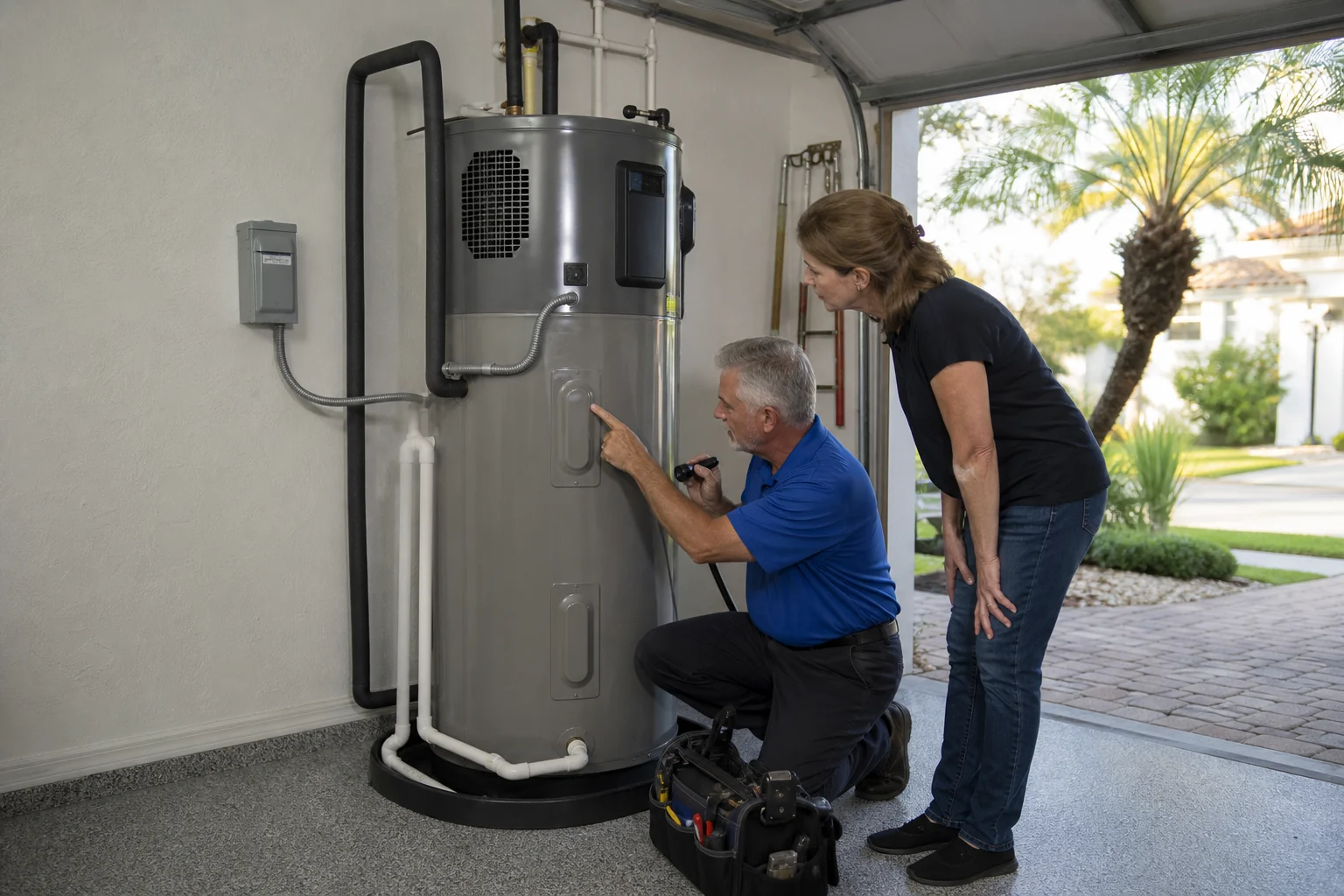
Repair versus replacement depends on the diagnosed failure, safety, leak condition, service history, warranty, household hot-water demand, equipment fit, installation constraints, permit/inspection route, and complete installed cost—not age alone. Ask for repair and replacement scopes side by side and require each to state what is included, excluded, assumed, and warranted.
Five things to remember
- Use a professional diagnosis for fuel, electrical, pressure, relief, venting, combustion, tank, or concealed issues.
- Compare repair and replacement as complete scopes.
- Include removal, access, drainage, venting, gas/electrical, expansion, permits, inspection, and commissioning.
- Match equipment to peak demand and the real installation space.
- Keep EnergyGuide, model/serial, warranty, permit, inspection, and final settings.
Print the water-heater decision worksheet
Compare diagnosis, repair, replacement, installed scope, demand, permit, warranty, and final documentation.
Repair and replacement decision matrix
Swipe sideways to see every column| Factor | Repair discussion | Replacement discussion |
|---|---|---|
| Diagnosis | Specific failed part and evidence | Whether failure/condition is resolved by replacement |
| Safety/condition | Can it be safely and durably repaired? | What installation deficiencies must be corrected? |
| Warranty | Part/labor coverage and remaining terms | Equipment, labor, registration, maintenance terms |
| Demand | Will current capacity/recovery remain suitable? | Peak-hour demand, first-hour or flow performance |
| Installed scope | Repair access, test, cleanup | Removal, access, connections, venting, gas/electrical, drainage, expansion, permit |
| Future record | Repair invoice and retest | Model/serial, EnergyGuide, permit/final, commissioning, warranty |
Symptoms that change the first response
Leave and use emergency/utility help
Do not operate switches or attempt equipment control in an unsafe area.
Use only known safe controls and urgent professional help
Do not assume the visible drip identifies the failed component.
Record fuel/energy status, fixtures, demand, and timing
Do not remove panels or adjust controls.
Compare the full installed system
Equipment price alone omits site constraints and related work.
Make the replacement scope complete
Equipment
- Type, fuel/energy, capacity, efficiency, model
- Peak demand and recovery/flow basis
- EnergyGuide and warranty
Site
- Access and removal
- Venting/combustion or electrical service
- Drainage, pan, relief discharge, expansion, structural/clearance needs
Closeout
- Permit/inspection when required
- Startup/commissioning and settings
- Manuals, registration, maintenance, disposal
A decision record that survives the sales conversation
Diagnosis
Record the failed component, evidence, safety condition, and untested limits.
Two paths
Request repair and replacement scopes with total assumptions.
Property fit
Confirm demand, space, energy source, connections, drainage, access, and related trades.
Authority
Confirm permit, inspection, installer, and final-record responsibilities.
Handoff
Keep model/serial, EnergyGuide, settings, test, invoice, warranty, and maintenance.
Efficiency is one part of ownership—not the only part
Compare expected household demand, installed efficiency, local energy rates, maintenance, space conditions, noise, recovery, outage behavior, warranty, repair access, and complete installed cost. Avoid a universal 'best type' claim.
Related next steps
Use the guide that matches the situation.
How this resource was made
Methodology and limits
The guide uses ENERGY STAR and FTC equipment information plus the City of Tampa water-heater inspection checklist as a local example, without turning one jurisdiction's process into a regional rule.
- Only onsite assessment can determine equipment condition and code/installation scope.
- Energy use depends on household demand, climate, equipment, settings, and installation.
- Rebates, products, prices, and permit processes change.
Sources
Reviewed sources
- Why Energy Efficiency MattersU.S. Department of Energy · Reviewed 8/17/2026
- Energy SaverU.S. Department of Energy · Reviewed 8/17/2026
- Residential Water Heaters: Key Product CriteriaENERGY STAR · Reviewed 8/27/2026
- How Heat Pump Water Heaters WorkENERGY STAR · Reviewed 8/27/2026
- EnergyGuide LabelsFederal Trade Commission · Reviewed 8/27/2026
- Water Heater Replacement Virtual Inspection ChecklistCity of Tampa · Reviewed 8/27/2026
Reviewed by Plumbers in Tampa Bay on 8/27/2026.