Tampa Bay homeowner guide
Local authority matrixBackflow prevention in Tampa Bay: a homeowner overview
Backflow prevention helps protect a drinking-water system when water could reverse direction through a connection. Requirements, device types, testing schedules, and responsibility can differ by water provider, property type, and local rule, so use the official authority that serves the property before treating any general guidance as a requirement.
On this page
The short answer
What to do first
Backflow prevention protects drinking-water systems from reverse flow at cross-connections, but the device, test frequency, permit, notice, and responsible party depend on the serving authority, connection, and property use. Identify the water provider and notice first; use a properly certified tester when required; and do not adjust, bypass, or treat a directory profile as proof of certification.
Start here
Route the notice before arranging work.
Use the serving water authority and the exact system—not the mailing city or a neighboring property—to choose the next step.
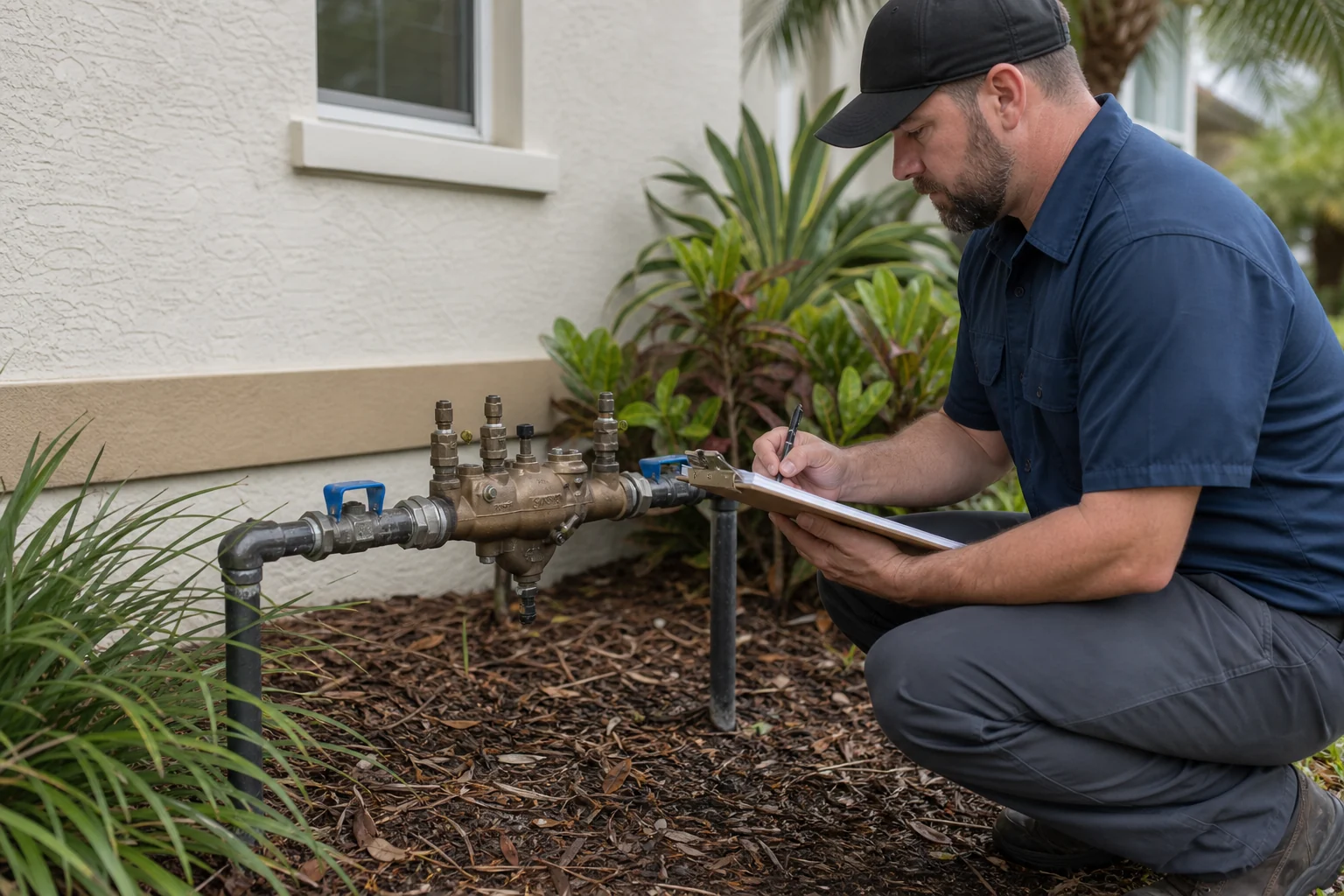
Five things to remember
- Start with the serving water authority, not the mailing city.
- Keep irrigation, fire, commercial, residential, well, pool, and internal plumbing boundaries separate.
- A test report and a repair invoice answer different questions.
- City of Tampa and Hillsborough County requirements are not universal across Tampa Bay.
- Save notices, tester credentials, device details, report, repair, permit, inspection, and acceptance.
Print the backflow document checklist
Record authority, device, notice, certified tester, report, repair, permit, inspection, and acceptance.
Follow the water boundary—not the appearance of the device
This conceptual diagram shows the service-connection boundary. It does not identify an assembly type or replace the authority's installation drawing.
Treated water enters the service connection.
The serving utility's account boundary applies.
The approved protection allows normal forward flow.
Water continues toward fixtures and connected systems.
Irrigation, well, pool, equipment, fire, or another condition can create risk.
Backpressure or a utility pressure drop can reverse the expected direction.
The device is the protection boundary; it must not be bypassed or adjusted casually.
Testing verifies the required performance at that time.
Two local examples—and why the address still controls
Swipe sideways to see every column| Authority | Published starting point | Do not generalize |
|---|---|---|
| City of Tampa Water | The official page describes its residential and commercial testing schedules, notice response, tester, and reporting process | Only for addresses and devices in that program |
| Hillsborough County Water Resources | The official page describes service-connection testing and permit/inspection/report routes for certain new, replaced, or relocated assemblies | County utility service is not the same as every Hillsborough mailing address |
| Other Tampa Bay provider | Use that provider's current cross-connection program | Do not copy Tampa or county frequencies |
| Fire-protection system | Use the authority and appropriately qualified fire-system professional | Do not treat as ordinary irrigation/plumbing work |
Five Tampa Bay programs can assign different roles
Use this as a routing comparison only. The selected utility's current notice, program page, manual, and staff answer control.
Swipe sideways to see every column| Serving authority | Published customer starting point | Tester or maintenance boundary | Record to request |
|---|---|---|---|
| City of Tampa Water | Respond to the device notice and published due date | Use a certified tester registered in the City's reporting system | Submitted test result, repair/retest when needed, and SwiftComply acceptance |
| Hillsborough County Water Resources | Arrange the annual test for an existing assembly | Use a registered County-certified tester; new, replacement, or relocated service assemblies also use the permit/inspection route | BMP submission; failed-test notice; permit closure when applicable |
| Pinellas County Utilities | Confirm whether the assembly is in the County utility program | County materials describe utility testing and maintenance for specified assemblies; customer access and charges can apply | Utility account record, service action, and current fee or maintenance status |
| Manatee County Utilities | Property owner arranges annual compliance for an owned assembly | Use a County-recognized provider and re-certify after repair | Test result, repair/re-certification, and online account status |
| Sarasota County Public Utilities | Water customer responds to the utility notice | Use a utility-approved tester; commercial program materials describe yearly testing | Submitted result, confirmation number, repair/retest, and resolved notice |
A county name is not enough: a property may be served by a city, county, private utility, or another system with its own program.
From notice to accepted record
Identify authority and device
Match the service address, account/notice, device location, type, size, serial, and program.
Verify the tester
Confirm the certification and any program registration required by the authority.
Test and document
Keep the report, readings/result, device identification, tester, and date.
Repair or replace if required
Separate test, repair, permit, inspection, retest, and report submission.
Confirm acceptance
Record the authority's received/accepted status and next due date.
Build the complete device record
Authority
- Serving provider and program
- Notice, account/reference, deadline
- Current contact and submission route
Device
- Location, type, size, serial
- What connection/system it protects
- Access, enclosure, freeze/flood, drainage condition
Compliance
- Tester credential
- Test/report
- Repair/replacement, permit/inspection, retest, acceptance
Keep three records that answer three different questions
Swipe sideways to see every column| Record | What it establishes | What it does not establish |
|---|---|---|
| Test report | The identified assembly's measured test result at the recorded time | That every plumbing or cross-connection condition at the property was inspected |
| Repair or replacement record | The parts, assembly, scope, responsible business, and date of corrective work | That the authority received or accepted a passing result |
| Retest and authority acceptance | The post-work result and the program's received or accepted status | Future performance, general workmanship, or endorsement of the tester |
If the authority uses a portal, ask the tester for the confirmation or status the authority recognizes—not only an invoice.
Property and system type change the questions
Confirm provider program and irrigation boundary
Do not assume the device or schedule from a neighboring property.
Confirm program, access, occupancy, and device inventory
More than one assembly or internal hazard may apply.
Use the fire-protection route
Do not test or modify as ordinary plumbing.
Explain every water source and connection
The cross-connection assessment depends on the actual system.
A pressure complaint does not authorize device adjustment
Record whether pressure is fixture-specific, hot-only, whole-property, intermittent, or neighborhood-wide. Contact the serving utility and an appropriate qualified professional rather than turning screws, bypassing a device, or assuming a failed test is the cause.
Related next steps
Use the guide that matches the situation.
How this resource was made
Methodology and limits
This guide compares current official starting points from City of Tampa Water, Hillsborough County Water Resources, Pinellas County Utilities, Manatee County Utilities, and Sarasota County Public Utilities. It treats every schedule, tester rule, ownership boundary, portal, and deadline as authority-specific rather than a Tampa Bay-wide rule.
- Authority rules, contacts, portals, deadlines, and program boundaries can change after the review date.
- The guide cannot identify a device, determine the hazard, or decide a test requirement from a photograph.
- Residential, commercial, irrigation, fire, reclaimed-water, well, pool, internal, and service-connection assemblies can follow different programs.
- A passing test is a point-in-time compliance record, not a plumbing inspection, endorsement, or guarantee.
Sources
Reviewed sources
- Backflow Testing and Cross-Connection ControlCity of Tampa · Reviewed 8/29/2026
- Backflow and Cross Connection Service TestingHillsborough County · Reviewed 8/29/2026
- City of TampaCity of Tampa · Reviewed 8/17/2026
- Hillsborough CountyHillsborough County · Reviewed 8/17/2026
- Cross-Connection Control and Backflow Prevention ManualCity of Tampa · Reviewed 8/29/2026
- Backflow Prevention Assembly ChargePinellas County Utilities · Reviewed 8/29/2026
- Utilities Policy ManualPinellas County Utilities · Reviewed 8/29/2026
- Cross Connection Control ProgramManatee County Utilities · Reviewed 8/29/2026
- Cross-Connection Control ProgramSarasota County Public Utilities · Reviewed 8/29/2026
Reviewed by Plumbers in Tampa Bay on 8/29/2026.