Tampa Bay homeowner guide
Decision guideWho handles a plumbing problem in a Florida condo or HOA?
A practical decision guide for Florida condo owners, HOA homeowners, residents, and property contacts who need to report a leak, identify the governing documents, understand what a pipe serves, and keep repair responsibility separate from water-damage and insurance questions.
On this page
The short answer
What to do first
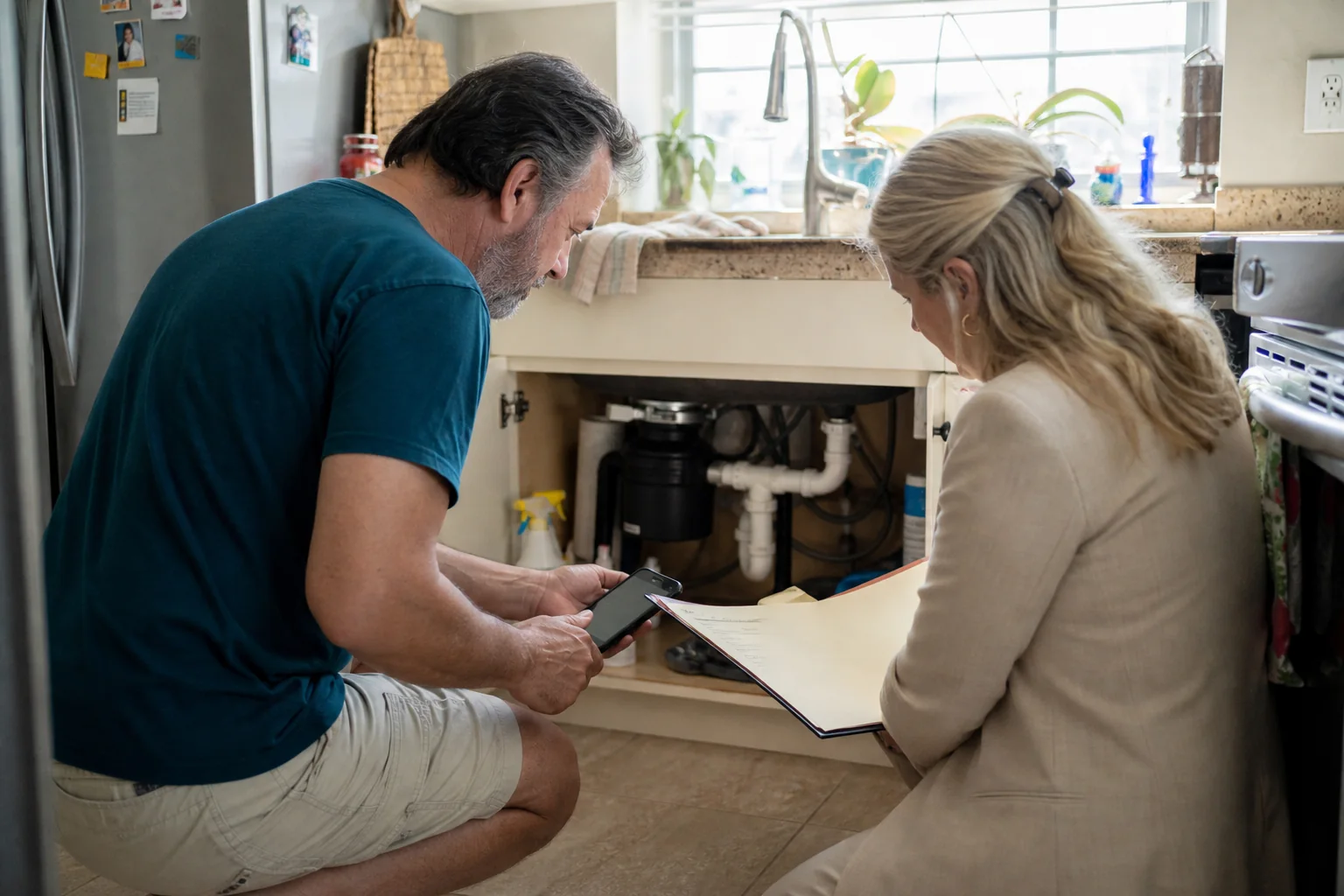
First identify whether the property is legally a condominium, an HOA parcel, or another arrangement. In a Florida condominium, the declaration defines unit boundaries and can assign maintenance duties; state law includes plumbing installations serving more than one unit or the common elements within the description of common elements, which the association generally maintains. A pipe serving one unit is only a clue—not a final answer—because its location, the declaration, limited-common-element language, insurance rules, and the cause of damage can change which party handles each part. In an HOA, start with ownership of the parcel and common area plus the recorded covenants. Always separate the failed-component repair from access, drying, finish restoration, personal-property damage, deductibles, and possible liability.
Five things to remember
- A townhome’s appearance does not tell you whether it is legally a condominium or an HOA parcel; check the recorded documents.
- For a Florida condo, identify the unit boundary, common elements, limited common elements, maintenance clause, and what the plumbing serves.
- The property manager may coordinate access and vendors without becoming the party that legally owns, insures, or pays for the component.
- Repairing the failed pipe, opening and restoring a wall, drying the property, and paying for damaged belongings are separate questions.
- Report promptly, preserve evidence, and ask for every responsibility or coverage decision in writing.
Print the responsibility and incident worksheet
Two clean pages: a responsibility decision sheet plus a document, contact, and incident record to use with management, insurers, and plumbers.
Start with the condition in front of you
Do not wait for a responsibility debate before addressing an immediate hazard or reporting active damage.
Leave the area and use emergency guidance
Keep people away. Contact emergency services or the responsible utility before a plumber or property-responsibility discussion.
Reduce flow only if the correct shutoff is known and safe
Do not force a valve or operate shared building equipment. Notify the association, property manager, or building emergency contact and arrange qualified help.
Avoid contact and stop using affected fixtures
Keep people and pets away. Report the condition promptly to the building contact and the appropriate plumber or utility.
Document, report, and identify the authorizing party
Photograph visible conditions, note affected fixtures and units, and ask who may approve diagnosis, access, and repairs.
Confirm what kind of property this legally is
A row of attached homes can be a condominium, an HOA community, a cooperative, or another arrangement. The exterior design is not the answer.
Read the declaration and Chapter 718 framework
Find the unit boundary, common-element and limited-common-element definitions, maintenance provisions, insurance provisions, and current amendments.
Start with parcel ownership and recorded covenants
The owner commonly maintains the home and parcel while the association handles property or systems it owns or is obligated to maintain—but the governing documents control the actual duty.
Use the deed and recorded declaration
Do not assume ‘HOA’ because the home has its own entrance, or ‘condo’ because walls are shared.
Add the lease or other governing instrument
Notify the owner or building contact. Additional documents and laws may apply beyond this guide.
Use a responsibility matrix—not a single rule of thumb
These are starting questions, not universal conclusions. Confirm the current documents and the actual system before authorizing work.
Swipe sideways to see every column| Plumbing situation | Start with | What still must be confirmed |
|---|---|---|
| Faucet, toilet component, disposer, appliance connection, or supply hose inside one unit | Unit owner or resident contact | Unit boundary, alteration history, maintenance clause, warranty, lease, and whether the issue damaged other property |
| Branch supply or drain that appears to serve only one condo unit | Declaration plus a plumber’s scope | Whether the pipe lies inside the unit boundary, is a limited common element, or has maintenance assigned differently |
| Riser, stack, main, or installation serving more than one condo unit | Association or property manager | Florida law includes multi-unit utility installations in common elements; confirm access, exact failure location, and declaration provisions |
| Pipe inside a wall, ceiling, slab, or chase | Do not decide from location alone | Unit boundary, what the pipe serves, limited-common-element language, and who may authorize opening and restoration |
| Exclusive-use limited common element | Declaration’s maintenance allocation | The association may maintain it, or the declaration may assign maintenance or cost to the benefiting owner |
| Plumbing within an HOA home or parcel | Parcel owner plus HOA governing documents | Whether the association owns or is obligated to maintain any shared building, common-area, irrigation, utility, or private infrastructure |
| Water service line or private sewer lateral | Serving utility’s boundary plus property documents | Where utility ownership ends, whether the association or owner controls the customer-owned portion, and local permit requirements |
| Property manager schedules the plumber | Treat the manager as coordinator unless documents say otherwise | Who owns the component, who has authority to approve the scope, and which account or insurer pays |
Florida Statutes § 718.108 identifies multi-unit utility installations as common elements, and § 718.113 assigns common-element maintenance to the association except where the declaration assigns limited-common-element maintenance. The declaration and actual facts still matter.
Read the documents in the right order
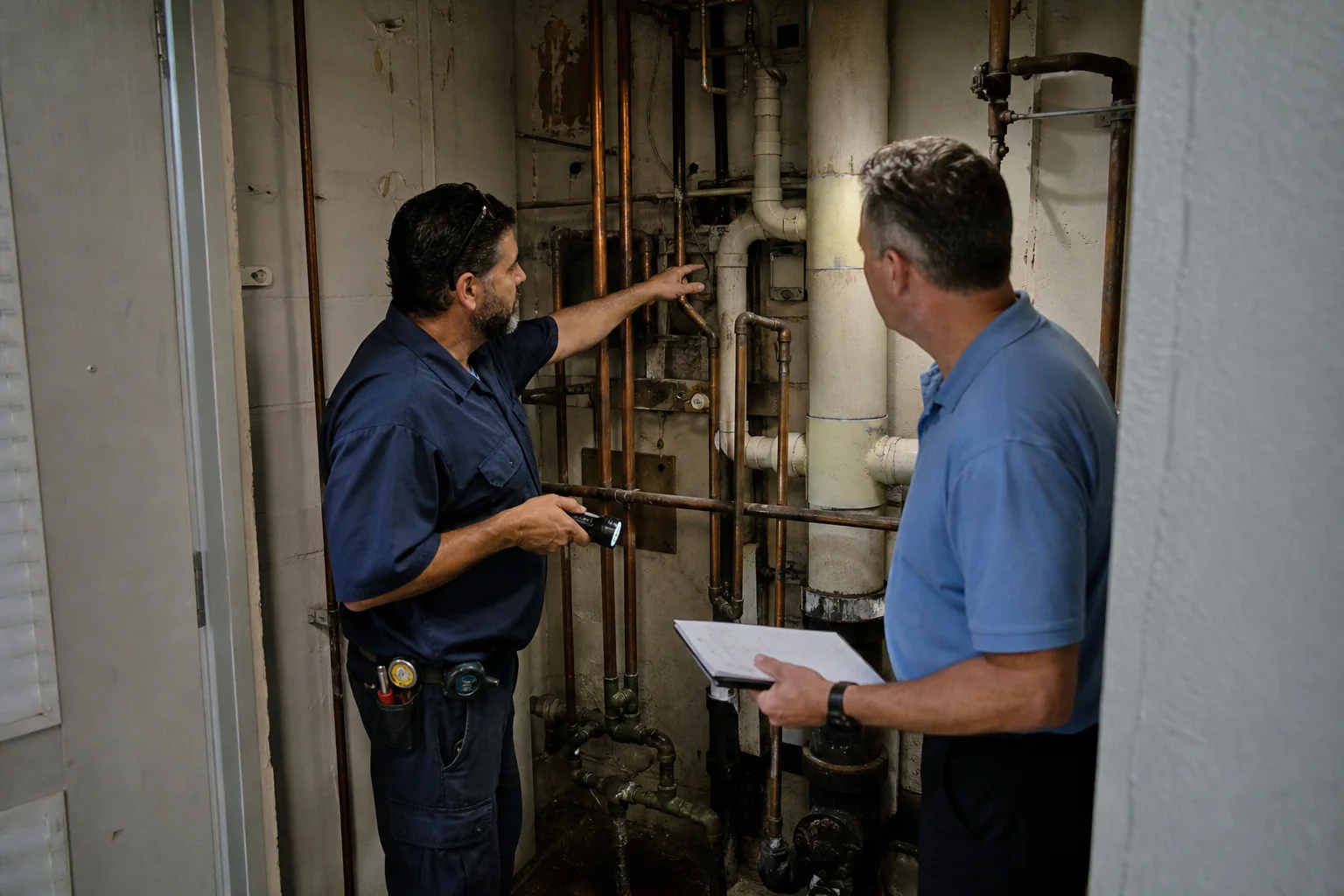
Use current, recorded versions and amendments. A summary, resale packet, maintenance chart, or manager email can help, but it should be checked against the controlling documents.
Property and boundaries
- Deed or ownership record showing whether the property is a condominium or HOA parcel
- Recorded declaration and all current amendments
- Survey, plot, unit-boundary description, and exhibits
- Definitions of unit, common element, limited common element, common area, and parcel
Maintenance and access
- Maintenance, repair, and replacement allocation
- Utility, plumbing, riser, stack, branch-line, and lateral language
- Emergency-entry and association-access provisions
- Alteration rules and approvals for owner-installed fixtures or improvements
Money and coverage
- Association master policy and current coverage summary
- Owner HO-6, homeowners, landlord, or renters policy
- Deductible and loss-assessment provisions
- Written incident, vendor, estimate, invoice, and claim records
Treat one leak as several separate decisions
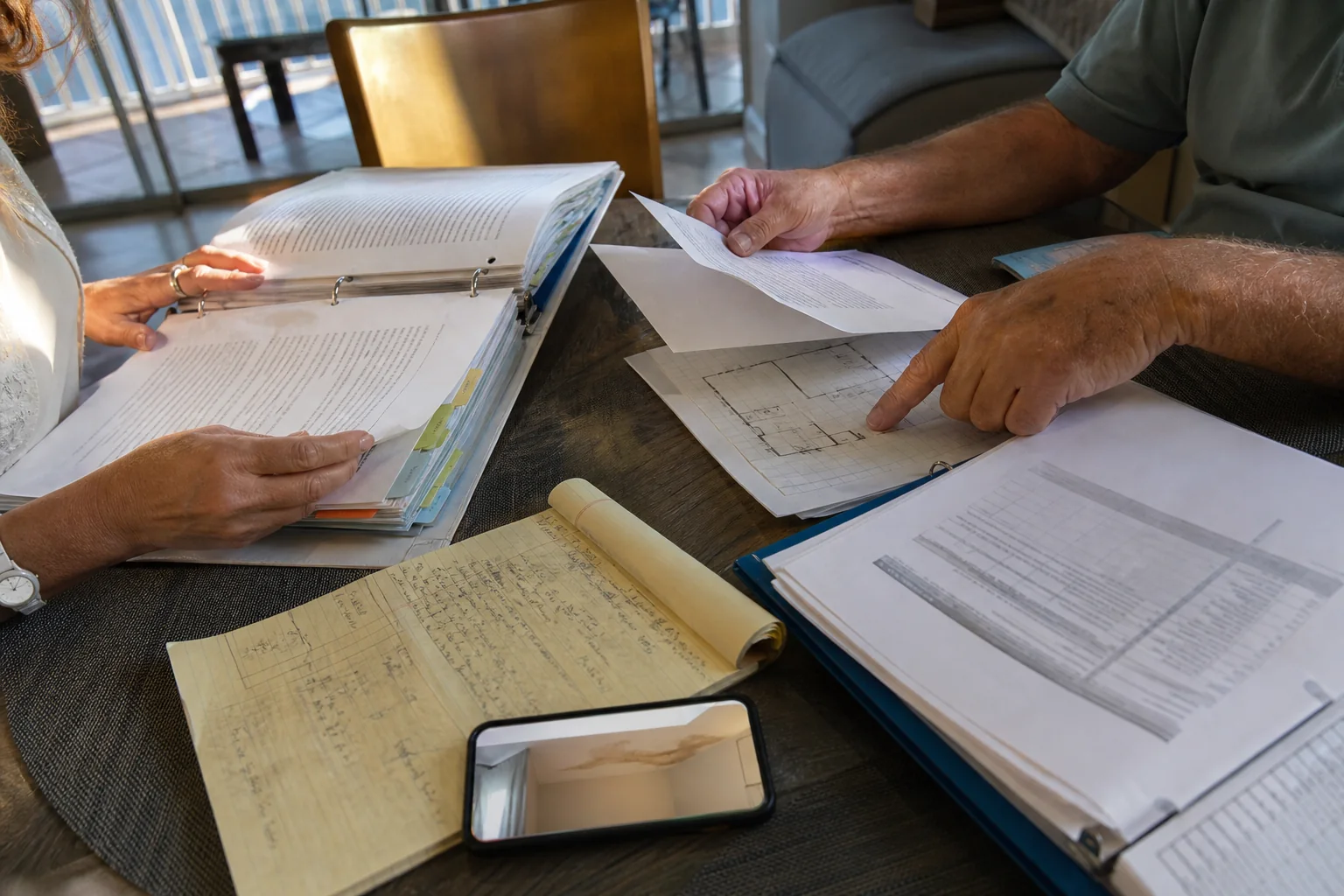
A fast answer to ‘who fixes the pipe?’ does not resolve every cost created by the event.
Swipe sideways to see every column| Decision | Question to ask | Evidence to keep |
|---|---|---|
| Stop or diagnose the leak | Who may access the area and authorize emergency or diagnostic work? | Time reported, photos, affected fixtures, shutoff status, messages, and vendor findings |
| Repair the failed component | Who has the maintenance duty for this exact pipe, fixture, appliance, valve, stack, riser, or lateral? | Declaration clause, boundary drawing, plumber’s written scope, and repair invoice |
| Open and restore a wall, ceiling, floor, or cabinet | Is access work part of the plumbing repair, association property, owner property, or a separate restoration scope? | Before-and-after photos, written approval, materials removed, and restoration estimate |
| Dry and mitigate | Who is coordinating safe drying and what does each insurer require before disposal or permanent repair? | Moisture or mitigation records, dates, photos, receipts, and insurer instructions |
| Replace finishes or personal property | Which policy or party addresses flooring, paint, cabinets, contents, upgrades, or another unit’s property? | Inventory, receipts, photographs, policy correspondence, and estimates |
| Deductible, assessment, or uncovered amount | Does the statute, declaration, policy, or a valid association decision allocate this cost? | Policy pages, association notice, meeting record, invoice, and written explanation |
| Negligence or reimbursement claim | Is someone alleging delayed reporting, improper work, intentional conduct, or failure to maintain? | Chronology, prior complaints, maintenance records, notices, expert findings, and legal advice when needed |
Florida’s condo-insurance statute distinguishes insured-event reconstruction from maintenance allocation and includes exceptions. A policy or claim professional must apply the current wording to the actual loss.
Work through the scenario before assuming who pays
These examples show the next question to ask. They do not decide a real dispute.
Start with the unit side
Stop water safely if possible, report damage, and check the unit-maintenance and insurance provisions. Damage beyond the fixture creates separate questions.
Report a possible shared-system issue
Contact building management or the association. Ask the plumber or utility to identify whether the source is a shared stack, riser, main, or public system.
Check both the boundary and maintenance clause
‘Inside the wall’ and ‘serves one unit’ are relevant facts, but neither alone necessarily controls the declaration.
Notify both units and the association
The visible origin does not automatically decide liability. Preserve evidence and notify the relevant insurers while the source and governing duties are established.
Separate equipment, building, and damage
Check ownership and maintenance of the heater, access or drainage, association-insured property, owner-insured items, and damage to other units.
Map the parcel, common area, and utility boundary
Determine whether the lateral is owner property, association infrastructure, or utility property. Pinellas and Tampa examples show why local boundaries must be verified.
Coordinate promptly and in writing
Florida law gives condo associations access in specified circumstances for common-element work or damage prevention. Confirm timing, protection, restoration, and vendor scope.
Request the basis without delaying mitigation
Ask for the current declaration section, maintenance chart, or policy basis and keep the response. Escalate disputed interpretations to qualified counsel or coverage professionals.
Use a clean contact sequence
Parallel notice is often more useful than waiting for one party to finish before contacting the next.
Make the area safe
Use emergency services or the responsible utility for immediate danger. Avoid wastewater and water near electricity. Operate only a known, safely accessible household or fixture shutoff—not shared building equipment.
Notify the building contact
Contact the association, property manager, landlord, or building emergency line promptly when shared property, another unit, building access, or common systems may be involved.
Get a written plumbing scope
Ask the plumber to identify the observed failure, component, location, what it serves, immediate work, recommended permanent work, and access or restoration needed—without asking the plumber to make a legal ruling.
Notify the relevant insurer or agent
Report according to the policy instructions. Ask what documentation, mitigation, inspection, or approval is required before disposal or permanent restoration.
Match the facts to current documents
Compare the written scope with the unit boundary, common or limited common elements, maintenance allocation, alteration history, utility boundary, and insurance provisions.
Confirm decisions in writing
Record who is authorizing each scope, who is paying initially, what remains disputed, deadlines, access arrangements, and whether reimbursement or coverage is still under review.
Build one incident record everyone can use
A clear chronology is more useful than scattered texts, photos, and invoices.
At first report
- Date, time, location, and who discovered the condition
- Water, wastewater, odor, sound, pressure, or fixture symptoms
- Known shutoff action and whether water is still moving
- Units, common areas, or utility notices that may be involved
Evidence and scope
- Safe photographs and video before cleanup or permanent repair
- Written plumber, mitigation, utility, or building findings
- Exact component, location, what it serves, and access needed
- Estimates, approvals, permits where required, invoices, and warranties
Responsibility and coverage
- Declaration and amendment sections relied upon
- Association, manager, owner, utility, and insurer contacts
- Claim numbers, deductibles, reservation or denial letters, and deadlines
- Open questions, disputed items, and the next written follow-up date
If the parties disagree, narrow the disagreement
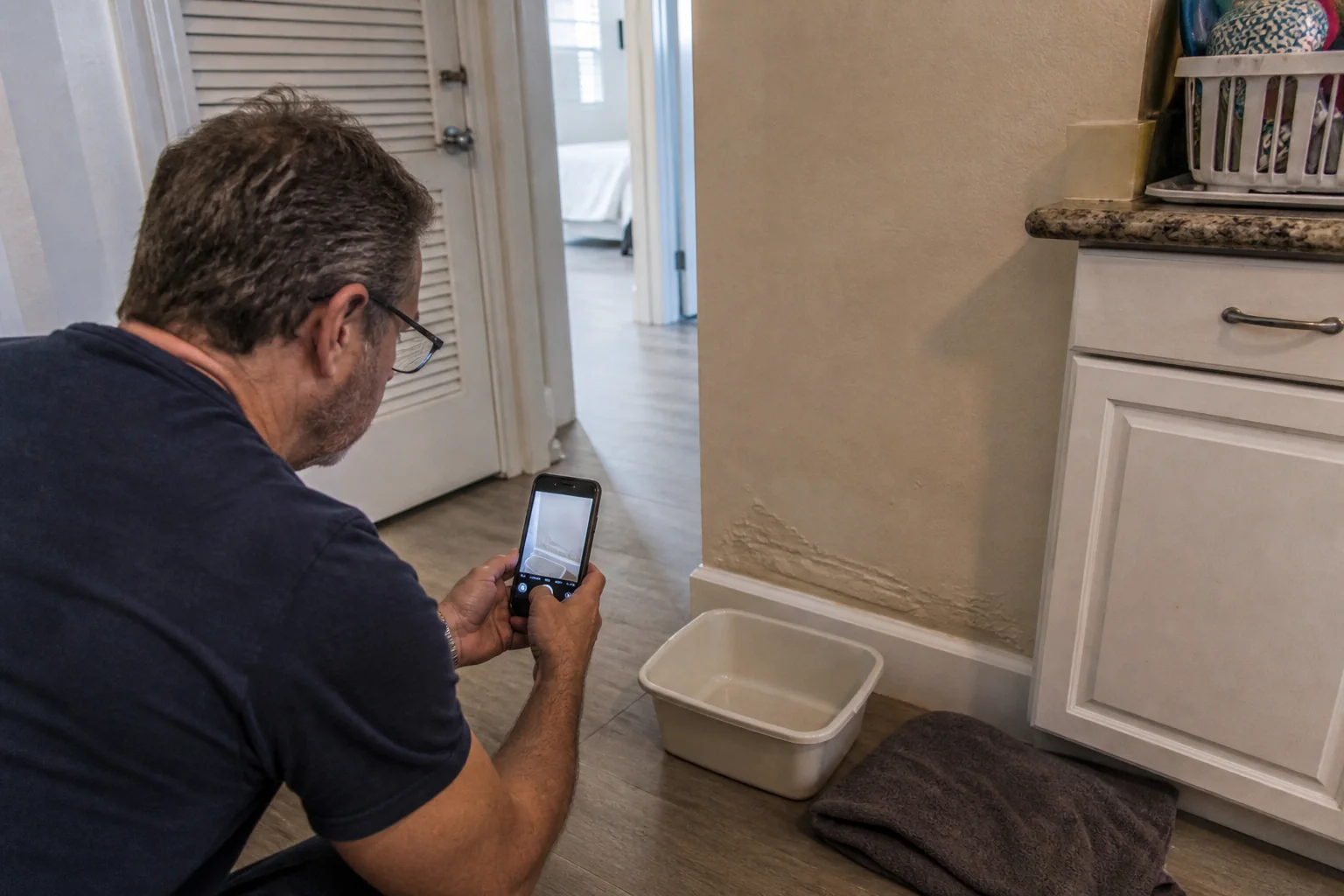
Ask each party to state the exact component, governing provision, insurance provision, and cost category they are accepting or declining. A disagreement about a shared pipe may be different from a disagreement about drywall, upgraded cabinets, a deductible, access damage, negligence, or another unit’s property. Preserve the building’s repair and mitigation progress while qualified professionals address the remaining legal or coverage issue.
- Do not sign an inaccurate scope merely to speed up work.
- Do not withhold prompt notice while waiting for a final allocation decision.
- Ask an insurer or licensed adjuster to explain policy decisions and a Florida attorney to interpret disputed legal duties.
- Use DBPR records resources for access to association documents, but do not assume DBPR decides every plumbing-liability dispute.
Related next steps
Use the guide that matches the situation.
How this resource was made
Methodology and limits
This resource was built from the current Florida Condominium Act and Homeowners’ Association Act, Florida DBPR owner resources, Florida consumer-insurance guidance, and Tampa Bay utility examples reviewed on August 26, 2026. It organizes the questions a homeowner needs to ask without deciding a specific party’s legal liability or insurance coverage.
- Declarations, amendments, bylaws, maintenance charts, management contracts, and insurance policies differ by community and can change.
- A plumber can diagnose and scope plumbing work but does not decide legal liability or insurance coverage.
- Coverage depends on the actual policy, cause, timing, exclusions, deductibles, and claim facts; notify the relevant insurer promptly.
- Utility ownership boundaries differ by provider and service area; confirm the current rule for the property rather than applying another jurisdiction’s example.
- Cooperatives, rentals, commercial units, and mixed-use or partial-building condominiums may follow additional documents or rules not fully covered here.
Sources
Reviewed sources
- Florida Statutes § 718.103: DefinitionsFlorida Legislature · Reviewed 8/26/2026
- Florida Statutes § 718.104: Contents of a Condominium DeclarationFlorida Legislature · Reviewed 8/26/2026
- Florida Statutes § 718.108: Common ElementsFlorida Legislature · Reviewed 8/26/2026
- Florida Statutes § 718.111: The AssociationFlorida Legislature · Reviewed 8/26/2026
- Florida Statutes § 718.113: MaintenanceFlorida Legislature · Reviewed 8/26/2026
- Florida Statutes § 720.301: HOA DefinitionsFlorida Legislature · Reviewed 8/26/2026
- Florida Statutes § 720.303: HOA Powers, Duties, and RecordsFlorida Legislature · Reviewed 8/26/2026
- Condominium and Cooperative FAQsFlorida Department of Business and Professional Regulation · Reviewed 8/26/2026
- Sample Request to Access Association RecordsFlorida Department of Business and Professional Regulation · Reviewed 8/26/2026
- Homeowners Insurance OverviewFlorida Department of Financial Services · Reviewed 8/26/2026
- Private Sewer Lateral Program FAQsPinellas County · Reviewed 8/26/2026
- 2024 Water Quality ReportCity of Tampa Water Department · Reviewed 8/26/2026
Reviewed by Plumbers in Tampa Bay on 8/26/2026.