Tampa Bay homeowner guide
Interactive decision guideIs it a drain, private sewer line, public sewer, or septic problem?
The same symptom can begin at a fixture, in the building drain, along a private sewer lateral, in a public collection system, or at a private septic system. This guide helps you sort the pattern and choose a safe first call without pretending to diagnose buried plumbing from a screen.
On this page
The short answer
What to do first
Stop using fixtures that make the problem worse. If sewage is entering the home, keep people and pets away and avoid contact. Then identify the pattern: one fixture, several fixtures, a lowest-level backup, outdoor sewage near a septic area, or a possible street/neighborhood problem. Use the decision tool below to choose a first contact. It organizes evidence; it does not diagnose the pipe or decide who must pay.
Five things to remember
- One slow fixture is different from several drains changing at once.
- Do not keep flushing or running water to test an active backup.
- A public-sewer customer can still have a private building drain or lateral problem.
- A septic system needs a separate branch, especially after flooding or saturation.
- Confirm the serving utility and property boundary before excavation or repair authorization.
Print the symptom and responsibility worksheet
Record affected fixtures, timing, system type, contacts, and the instructions you receive without trying unsafe tests.
Interactive routing tool
Choose the safest first call from the pattern you can observe.
No address or answer is saved. This tool routes a first step; it does not diagnose the pipe or assign responsibility.
Stop testing when the next test can spread wastewater
Use what is already visible. Do not create a second overflow to prove the first one.
Isolate the area
Stop fixture use, avoid contact, keep people and pets away, and follow current public-health and cleanup guidance.
Leave the area
Use emergency services or the responsible utility before inspecting plumbing.
Do not add another product
Tell the service professional the product, amount, and time used. Mixing chemicals can create dangerous reactions.
Do not open or force it
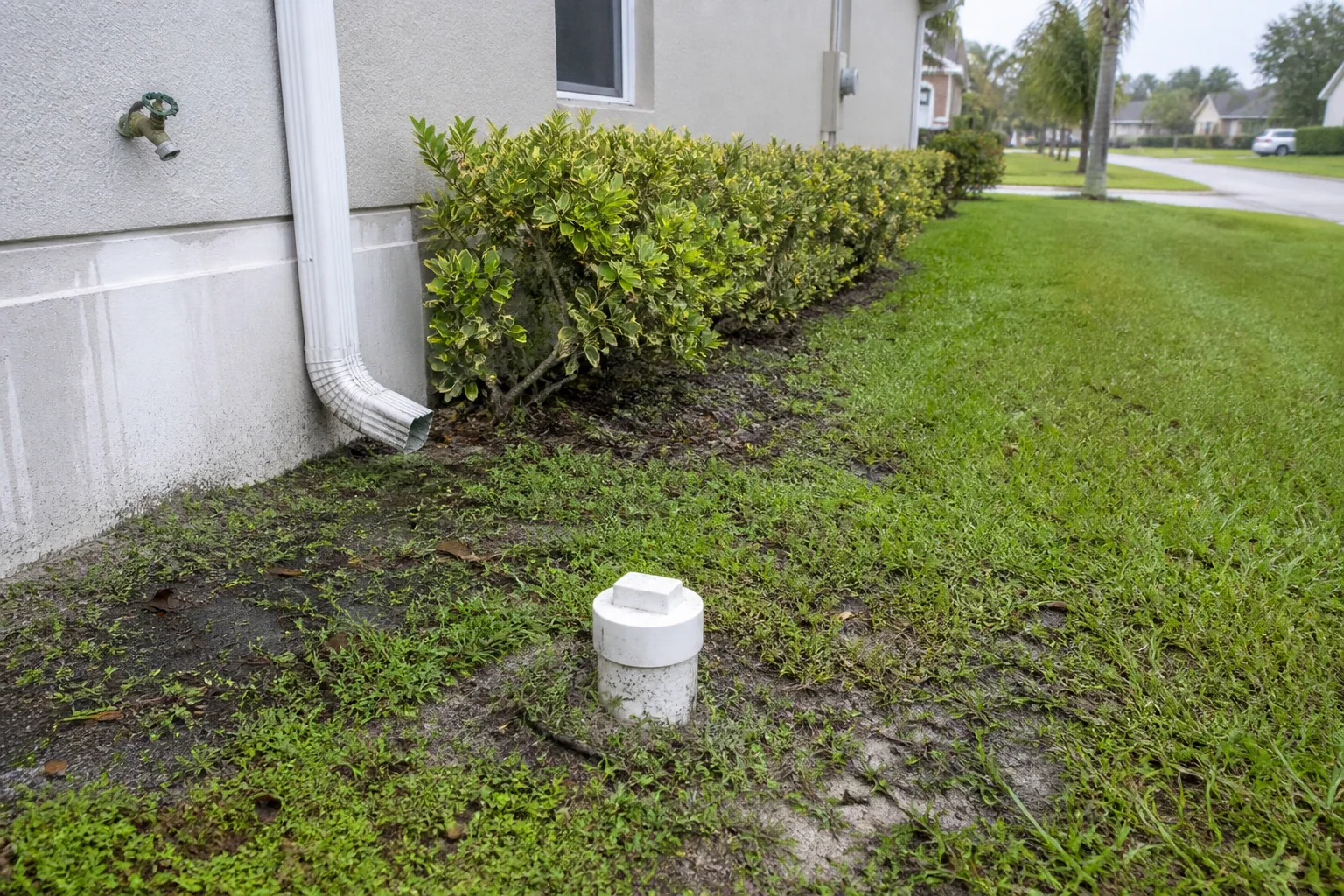
A cap, lid, valve, or buried feature can be unsafe, damaged, pressurized, or outside homeowner responsibility.
Read the pattern before naming the cause
These are routing clues, not diagnoses.
Swipe sideways to see every column| What you can observe | What it may involve | Useful first step |
|---|---|---|
| One sink, tub, shower, or toilet; nearby fixtures normal | Fixture trap, branch, stopper, or localized obstruction | Stop using that fixture; use the clogged-drain guide or a plumber if it persists |
| Several fixtures change together, especially a lowest drain | Building drain, private lateral, septic, or public collection issue | Reduce water use and contact a plumber or serving utility based on the system and notices |
| Water appears in another fixture when one is used | Connected drainage path downstream of both fixtures | Stop testing and document which action caused which response |
| Outdoor sewage, odor, wet area, or unusually lush patch near a septic field | Possible septic malfunction or surface discharge | Keep away and contact a qualified septic professional and the appropriate health authority |
| Neighbors or street infrastructure show similar symptoms | Possible public collection-system problem | Contact the serving wastewater utility and record the incident number |
| Problem begins during or after heavy rain | Inflow, infiltration, saturation, private-system stress, or an unrelated issue | Check official utility notices; do not assume weather alone identifies responsibility |
A public-sewer connection does not make every pipe on the property public. A septic tank or drainfield does not make every indoor clog a septic failure.
The first ten minutes: contain, observe, route
Stop adding water
Pause the affected fixture and any appliance or fixture that appears to trigger the backup.
Protect people
Keep everyone away from wastewater and any electrical, gas, structural, or flood hazard.
Map the symptoms
Note every affected fixture, the lowest affected point, odors, sounds, outdoor signs, recent rain, and recent high water use.
Identify the service type
Check a utility bill, property record, landlord, association, or serving authority to distinguish public sewer from private septic.
Make the first call
Use the tool result, then describe observations without asserting a diagnosis. Record who was called and the instructions received.
Keep five possible responsibility boundaries separate
Swipe sideways to see every column| Boundary | What it can include | Who to confirm with |
|---|---|---|
| Fixture or branch | Trap, stopper, fixture connection, or branch serving a limited area | Plumber, landlord, or building maintenance |
| Building drain | Drainage within or immediately serving the structure | Plumber plus owner, landlord, or association documents |
| Private sewer lateral | Pipe connecting private plumbing toward a public main; exact boundary varies | Serving utility, municipality, property records, and qualified plumber |
| Public collection system | Municipal or utility-owned sewer mains and related infrastructure | Serving wastewater utility |
| Private septic system | Tank, distribution components, drainfield, and connected building sewer | Qualified septic professional and Florida/local health authority |
Do not use a postal city, a logo on an old bill, or the location of a visible cap as proof of jurisdiction or ownership.
If the property uses public sewer
Use the Wastewater emergency contact
The City lists a 24/7 wastewater emergency line at 813-247-3451 and says it will check its lines and advise whether the problem is public or private.
Call a plumber and keep the utility boundary in mind
Ask the plumber what evidence separates a building drain, private lateral, and public main issue.
Contact the serving utility first
Report observations and location; do not enter a street, manhole, or flooded area.
Notify the responsible property contact promptly
A common stack, shared line, or building rule can change the correct first responder and access path.
If the property uses a private septic system
Reduce water use and call a qualified septic professional
Keep people and pets away from the affected outdoor area and do not open the tank.
Follow flood-specific septic guidance
Avoid use where directed and do not pump the tank while the system and surrounding soil remain flooded or saturated without qualified direction.
Do not assume the whole septic system failed
A fixture or branch issue remains possible; give the professional the full symptom pattern.
Use property records and qualified help
Do not probe, dig, drive, or operate equipment over a suspected tank or drainfield.
Give the plumber, septic professional, or utility the same useful facts
Symptoms
- Every affected fixture and the lowest affected drain
- What action triggers the symptom
- Whether wastewater is visible and where
- Sounds, odors, outdoor wetness, and recent recurrence
Property and system
- Public sewer, private septic, or not yet confirmed
- Single-family, rental, condo, HOA, commercial, or shared building
- Serving utility or septic service history if known
- Recent repairs, cleaning, excavation, or construction
Timing and conditions
- When it began and whether it is getting worse
- Recent heavy rain, flooding, outage, or utility notice
- Recent high water use or appliance discharge
- Products used and actions already taken
Questions that make a drain or sewer assessment easier to compare
Swipe sideways to see every column| Question | Why it matters | Record to request |
|---|---|---|
| What evidence identifies the affected section? | A symptom alone may not locate a defect | Written observation, test result, or video reference when used |
| Where does private responsibility end at this address? | Boundaries differ by utility and property | Utility confirmation or governing document, not only assumption |
| What will cleaning, camera work, locating, excavation, or repair include? | These can be separate scopes | Itemized written scope and exclusions |
| What changes the price after access or inspection? | Buried conditions and access can alter work | Change-approval process before extra work |
| Are permits, utility coordination, restoration, or cleanup included? | The pipe work may not be the whole project | Responsible party for each item |
| What result should exist when the job is complete? | A cleared symptom and a repaired defect are not always the same claim | Completion evidence, warranty, maintenance, and remaining limits |
Avoid the shortcuts that erase evidence or add risk
Do not repeatedly flush, run appliances, mix chemicals, open an unknown cleanout, enter a septic tank, lift a manhole, excavate around utilities, or accept a public-versus-private conclusion without the responsible authority. A safe record of the untouched symptom pattern is often more useful than another test.
- Do not describe clear water as safe if wastewater or floodwater may be involved.
- Do not treat a temporary return to normal as proof the underlying problem is gone.
- Do not authorize broad excavation from a guess about pipe location or ownership.
- Do not delay association, landlord, utility, insurer, or public-health notice while debating responsibility.
Tampa Bay official starting points
Swipe sideways to see every column| Situation | Official starting point | Use it for |
|---|---|---|
| City of Tampa wastewater | Wastewater contact page | Backups, overflows, collection-system questions, and current contact numbers |
| Hillsborough public water or sewer main | Report water and sewer main breaks | Possible utility main break or public system issue |
| Pinellas utility customer | Pinellas Utilities Services | Current utility contacts and service information |
| Pinellas private lateral | Private Sewer Lateral program | Current county program information and lateral responsibilities |
| Sarasota County sewer emergency | Sewer leaks and emergencies | Current sewer emergency reporting route |
| Private septic system | Florida Department of Health septic systems | State program information and local health-office direction |
Confirm the actual serving utility from the exact address. A city name in a mailing address does not prove the responsible provider.
Related next steps
Use the guide that matches the situation.
How this resource was made
Methodology and limits
This guide separates observable symptom patterns from responsibility and diagnosis. It was checked against EPA sewer and septic guidance plus current Tampa Bay utility and private-lateral resources. The interactive result uses only answers selected in the browser and does not save property information.
- Symptoms overlap; only an on-site assessment and the responsible authority can confirm the cause and boundary.
- Utility service areas and private/public responsibility rules vary by address and may change.
- The tool does not replace emergency, public-health, utility, septic, association, landlord, or professional instructions.
Sources
Reviewed sources
- Sanitary Sewer OverflowsU.S. Environmental Protection Agency · Reviewed 8/17/2026
- Sanitary Sewer Overflow Frequent QuestionsU.S. Environmental Protection Agency · Reviewed 8/17/2026
- How to Care for Your Septic SystemU.S. Environmental Protection Agency · Reviewed 8/17/2026
- Resolving Septic System MalfunctionsU.S. Environmental Protection Agency · Reviewed 8/27/2026
- Septic SystemsFlorida Department of Health · Reviewed 8/27/2026
- Wastewater DepartmentCity of Tampa · Reviewed 8/27/2026
- Contact Us: WastewaterCity of Tampa Wastewater Department · Reviewed 8/27/2026
- Wastewater Collection SystemCity of Tampa · Reviewed 8/27/2026
- Prevent Blocked DrainsCity of Tampa · Reviewed 8/27/2026
- Report Water and Sewer Main Pipe BreaksHillsborough County · Reviewed 8/17/2026
- Private Sewer Lateral Program FAQsPinellas County · Reviewed 8/26/2026
- Utilities ServicesPinellas County · Reviewed 8/27/2026
- Sewer Leaks and Sewer EmergenciesSarasota County · Reviewed 8/26/2026
- Safety Guidelines: Reentering Your Flooded HomeCenters for Disease Control and Prevention · Reviewed 8/17/2026
Reviewed by Plumbers in Tampa Bay on 8/27/2026.