Tampa Bay homeowner guide
Safety decision guideFind and use your main water shutoff safely
A known, reachable private shutoff can limit damage from a burst pipe or major indoor leak—but only when the path is safe and the valve is clearly yours to operate. This guide helps Tampa Bay households identify the right control before an emergency, avoid utility-owned or shared equipment, and record the location for everyone who may need it.
On this page
The short answer
What to do first
If water is escaping and the path is dry and safe, first stop the affected fixture or appliance with its known local valve. If that will not control the leak, use only a clearly identified private whole-home shutoff that moves gently by hand. Do not reach through standing water, operate an unfamiliar valve, open a utility meter box to use the curb stop, or touch shared building or fire-system controls. If the valve is unknown, stuck, corroded, or leaking, step back and call the responsible utility, building contact, or plumber for that boundary.
Five things to remember
- A fixture valve can stop one toilet, sink, or appliance without shutting down the whole property.
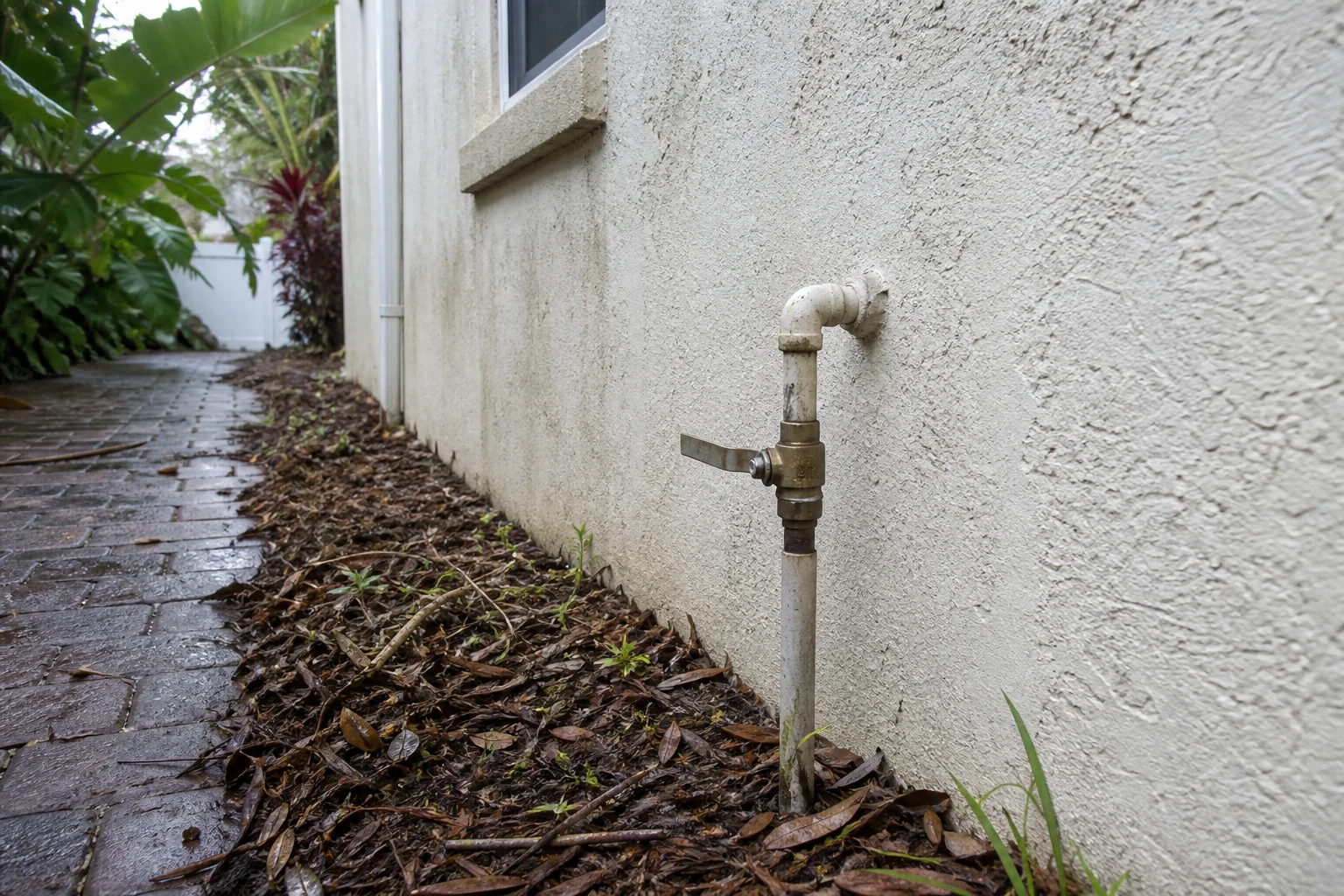
- A private main may be near the building and in line with the meter, but only confirmation establishes that it is yours to operate.
- Do not operate a utility curb stop, meter control, shared riser, fire-system valve, or any unfamiliar valve.
- Never force a stuck, corroded, buried, or leaking valve; arrange a qualified assessment instead.
- Photograph, label, and record the confirmed shutoff before hurricane season or an emergency.
Emergency shutoff card and household record
Print the one-page decision card, then record the confirmed fixture valves, private main, access route, and responsible contacts before an emergency.
Choose the safest control—not simply the biggest valve
Use this path only when you can remain on a dry, stable route without entering an electrical, gas, structural, fire, or wastewater hazard.
Use its known local valve
Close the familiar supply valve for that toilet, sink, washing machine, dishwasher, or other item if it is visible, reachable, and operating normally.
Use the confirmed private main
Shut off the building only when the control is clearly identified as the customer-side private valve and it turns gently by hand.
Call the responsible authority
Contact the serving water provider, property manager, association, landlord, or building emergency contact. Do not operate shared or utility equipment.
Leave the area
Do not cross water or touch equipment to reach a valve. Use emergency services or the responsible utility for the immediate hazard.
Distinguish a fixture valve, private main, and someone else’s control
The valve that is closest to the problem is often the safest useful control. Ownership and function matter more than size or appearance.
Swipe sideways to see every column| Control | What it usually affects | Homeowner boundary |
|---|---|---|
| Fixture or appliance valve | One toilet, sink, appliance, hose connection, or other branch | Operate only when it is familiar, accessible, and moving normally |
| Private whole-home shutoff | Most or all water entering one house or unit | Use only after the private valve and its access route have been confirmed |
| Building, riser, or shared manifold | Several units, a common area, or a building system | Contact the association, property manager, landlord, or building maintenance contact |
| Private-well controls | Pump, pressure tank, and private supply system | Use the well professional’s property-specific plan; avoid wet or damaged electrical controls |
| Meter, curb stop, street-side, or utility valve | Public service or the utility-to-customer boundary | Do not operate; contact the serving water provider |
| Fire-suppression control | Sprinkler or life-safety system | Do not operate as a plumbing shutoff; use building and emergency procedures |
Labels, colors, handle shapes, and proximity to a meter can be clues, not proof. If the control is not clearly private and confirmed, do not use it.
Locate and confirm the private main on a normal day
City of Tampa guidance says a private shutoff is typically on the side of the structure, low to the ground, and in line between the meter box and residence. Other properties may place it in a garage, utility room, crawlspace, mechanical closet, or another accessible point.
Trace the private side
- Identify the serving water provider and the meter location without opening or operating utility equipment.
- Look along the customer-side path from meter toward the building and at the building entry point.
- Check ordinary accessible spaces such as the garage, utility room, laundry area, or exterior wall.
- For a condo, rental, or shared property, ask the responsible building contact rather than guessing.
Confirm before labeling
- Ask a qualified plumber, property manager, landlord, association, well professional, or utility what the valve controls.
- Record whether it shuts one unit, the whole house, irrigation, a well system, or something shared.
- Confirm the access route is legal, unlocked, dry, stable, and reachable by the household.
- Resolve a missing, buried, damaged, stuck, or leaking private shutoff before an emergency.
Make the plan usable
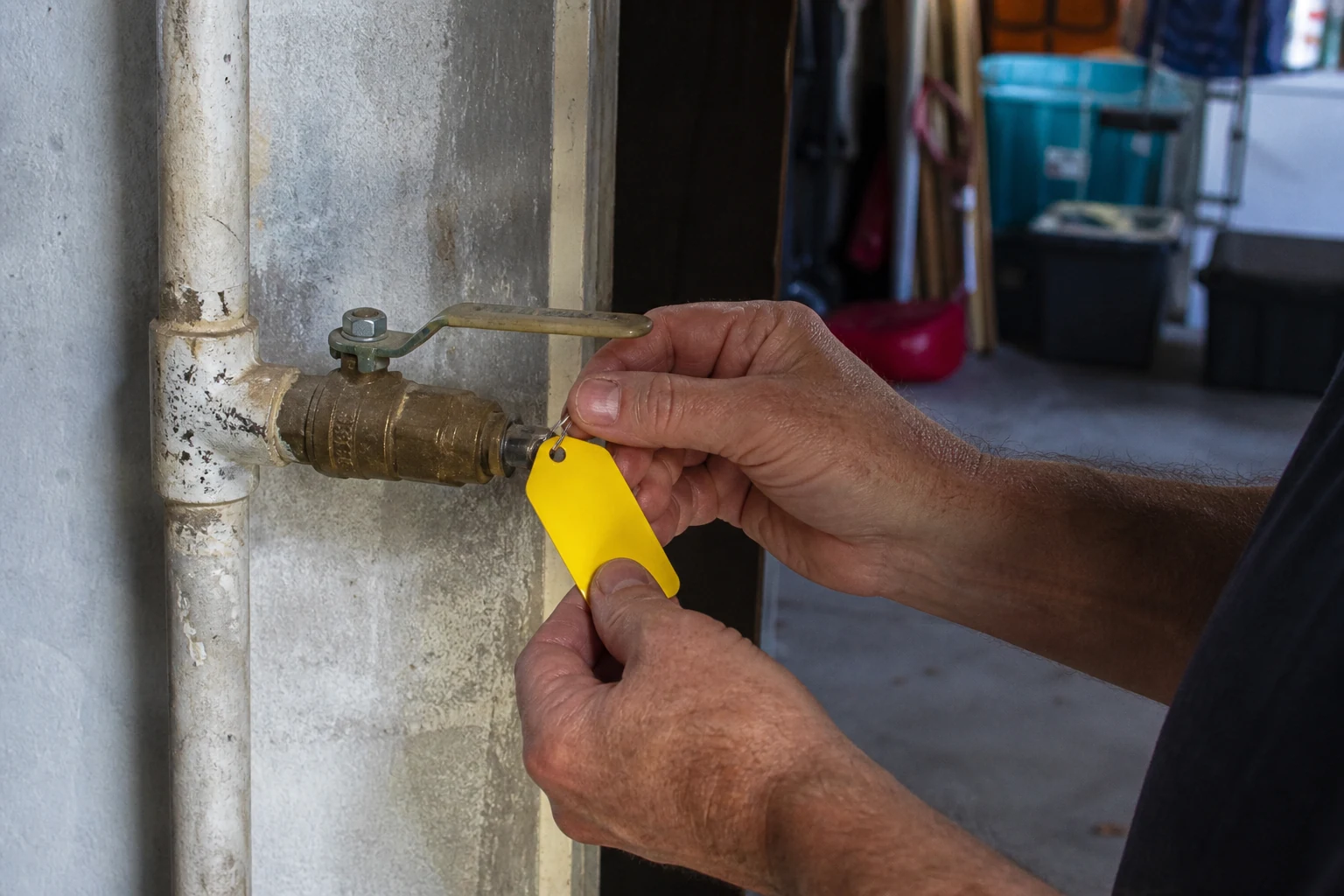
- Photograph the wider access route and a close view of the confirmed valve.
- Attach a simple weather-resistant tag only after confirmation.
- Record the location in plain language that another occupant can follow.
- Review the record with household members and refresh it after plumbing or property changes.
Use the property type to organize the search—not to identify a valve
Tampa Bay housing ranges from detached slab homes to raised homes, manufactured homes, condos, rentals, and private-well properties. These are safe search sequences for a normal day; none proves that a particular valve is private or appropriate to operate.
Swipe sideways to see every column| Property pattern | Safe places or people to check first | Stop and get confirmation when |
|---|---|---|
| Detached home without a basement | Trace the accessible customer-side route toward the building; check the exterior entry area, garage, utility or laundry space, and mechanical area | The only visible control is in a meter box, buried, locked, corroded, or close to irrigation or fire equipment |
| Raised home or accessible crawlspace | Check plans, inspection records, and visible entry points from a dry, stable area; ask a plumber where the service enters | Finding it would require entering a wet, pest-filled, confined, structurally questionable, or otherwise unsafe space |
| Condo, townhome, or multi-unit building | Ask the association or property manager for the unit shutoff, riser boundary, access procedure, and after-hours contact | Several similar valves, a locked service room, a shared manifold, or fire-system equipment is present |
| Rental or seasonal property | Use the landlord or manager's documented emergency plan and confirm who may access private versus shared controls | The written plan is missing, the access route has changed, or the person on site is not authorized to enter the service area |
| Manufactured or mobile home | Check the property documentation, park or community contact, and accessible service-entry area with a qualified professional | The route is beneath the home, near electrical equipment, shared with the site, or otherwise unfamiliar |
| Private-well property | Ask a qualified well professional to distinguish the plumbing shutoff from pump, pressure-tank, and electrical controls | Equipment is wet, damaged, energized, unfamiliar, or requires entry into an unsafe enclosure |
A handle shape, paint color, pipe size, or location near a meter, water heater, irrigation system, or well component is only a clue. Confirmation must establish what the control serves and who may operate it.
Recognize common valve clues without treating them as proof
A trained person can confirm the control and condition. These descriptions help you ask a better question; they do not authorize operation of an unknown valve.
Swipe sideways to see every column| What you see | Typical movement | Safe planning note |
|---|---|---|
| Lever-style ball valve | Often a quarter turn between aligned and crosswise positions | Only move a confirmed private valve gently by hand; never add leverage |
| Round wheel or gate-style valve | Usually several turns | Older valves may seize or leak at the stem; do not force or test during an emergency |
| Small stop behind a fixture | A short turn or several turns depending on style | Use only for the fixture it clearly serves and stop if it binds or leaks |
| Valve in a meter box or beside the street | Utility-specific | Treat it as utility equipment and call the serving water provider |
| Several tagged or similar valves together | Building- or system-specific | Assume shared or specialized controls until the responsible building contact confirms otherwise |
| No visible handle, heavy corrosion, burial, or active leakage | Unknown or unsafe | Do not improvise; arrange qualified repair or access work |
Rule out common look-alikes before anyone labels a main shutoff
The wrong valve can leave the leak running, interrupt another system, or create a new hazard. Use function and ownership—not appearance alone—to identify the control.
Swipe sideways to see every column| Possible false match | Why it may be mistaken for the main | Safe boundary |
|---|---|---|
| Water-heater cold-inlet valve | It is prominent and may be near other service piping | It controls the heater supply, not necessarily the rest of the property; include it only in a confirmed heater-specific plan |
| Sink, toilet, laundry, or appliance stop | It has a familiar handle and is easy to reach | It should isolate only the fixture or appliance it clearly serves |
| Irrigation valve or backflow assembly | It may sit outside near the service route and use similar piping | Do not treat irrigation or cross-connection equipment as the household main; use the serving authority or qualified professional |
| Gas valve or fuel control | A nearby pipe and quarter-turn handle can look similar | Do not use plumbing instructions on gas equipment; leave for a gas odor and use emergency or gas-utility guidance |
| Fire-sprinkler or life-safety control | It may be large, tagged, and near building water piping | Do not operate it as a leak shutoff; use building and emergency procedures |
| Meter-box, curb-stop, or street-side valve | It lies on the apparent route from the street to the building | Treat it as utility equipment unless the serving provider explicitly states otherwise; City of Tampa identifies its curb stop as City property |
| Shared riser, manifold, or neighboring-unit valve | Several similar controls may be grouped together | Use the association, property manager, landlord, or building maintenance contact before touching any control |
Never identify a valve by color alone. Tags can be missing, outdated, or wrong; verify what the pipe serves and update the household record after qualified confirmation.
If an emergency happens, use a short controlled sequence
This sequence applies only to a confirmed private valve on a safe route.
Clear the hazard gate
Leave for water near electricity, gas odor, fire, structural damage, sewage, or any unsafe access route.
Try the smallest known control
If one fixture or appliance is the clear source, use its familiar local valve first.
Confirm the private main
Match the location and photograph in the household record. Do not substitute a nearby unknown valve.
Move it gently by hand
Use normal hand pressure only. Stop if it binds, cracks, leaks, or requires a tool or added leverage.
Observe from a safe place
Confirm whether flow is slowing. Do not dismantle the valve or enter a newly hazardous area to investigate.
Call and document
Tell the plumber, building contact, or utility what control was used, what changed, and what remains unsafe or active.
Know what a private water shutoff does—and what it does not clear
Closing the correct private valve is damage control, not a declaration that every related hazard or system is safe.
Swipe sideways to see every column| Observation after shutoff | What it may mean | Next safe step |
|---|---|---|
| Flow slows but does not stop immediately | Residual pressure or stored water may remain in the private piping or equipment | Stay clear of hazards, observe from a safe place, and tell the responding professional exactly what changed |
| Flow continues strongly | The selected control may not serve the leak, may not be fully closing, or the source may be on another boundary | Do not add force or try nearby unknown valves; call the plumber, building contact, or serving utility |
| The valve begins dripping or the handle changes | The shutoff itself may be damaged or failing | Stop manipulating it, contain water only from a safe area, and report the valve condition |
| Sewage or drain water is backing up | A private supply shutoff does not clear a wastewater blockage, public-sewer issue, or septic problem | Avoid contact and use the wastewater, septic, building, or plumbing response for the actual boundary |
| Water remains near electrical, gas, structural, or fire equipment | The hazard remains even if incoming water has slowed | Do not enter or restart equipment; use emergency services and the responsible utility or qualified professional |
| A water heater, pump, appliance, or smart shutoff is involved | Stored water, energy, controls, and manufacturer-specific conditions may remain | Do not improvise fuel or electrical steps from this guide; give the responding professional the equipment details |
Do not reopen a questionable valve or restart equipment merely to test it. The responding professional should establish the safe restoration sequence for the actual property and failure.
Use a different plan for shared buildings and private wells
The correct control may not belong to an individual occupant, and some systems combine plumbing with electrical equipment.
Use the building emergency contact
A unit valve may be private, but a riser, manifold, locked room, roof equipment, or fire-system control may serve other units. Follow the association or manager’s procedure.
Use the landlord or manager’s confirmed plan
Record the approved shutoff and emergency contact before a leak. Do not enter locked service areas or operate shared controls.
Use a well-specific plan
Ask a qualified well professional which plumbing valve and electrical control apply. Do not touch wet, flooded, damaged, or unfamiliar pump equipment.
Do not treat it as a plumbing main
Operating the wrong control can disable life-safety protection. Use building and emergency procedures.
A valve that will not move gently is not ready for an emergency
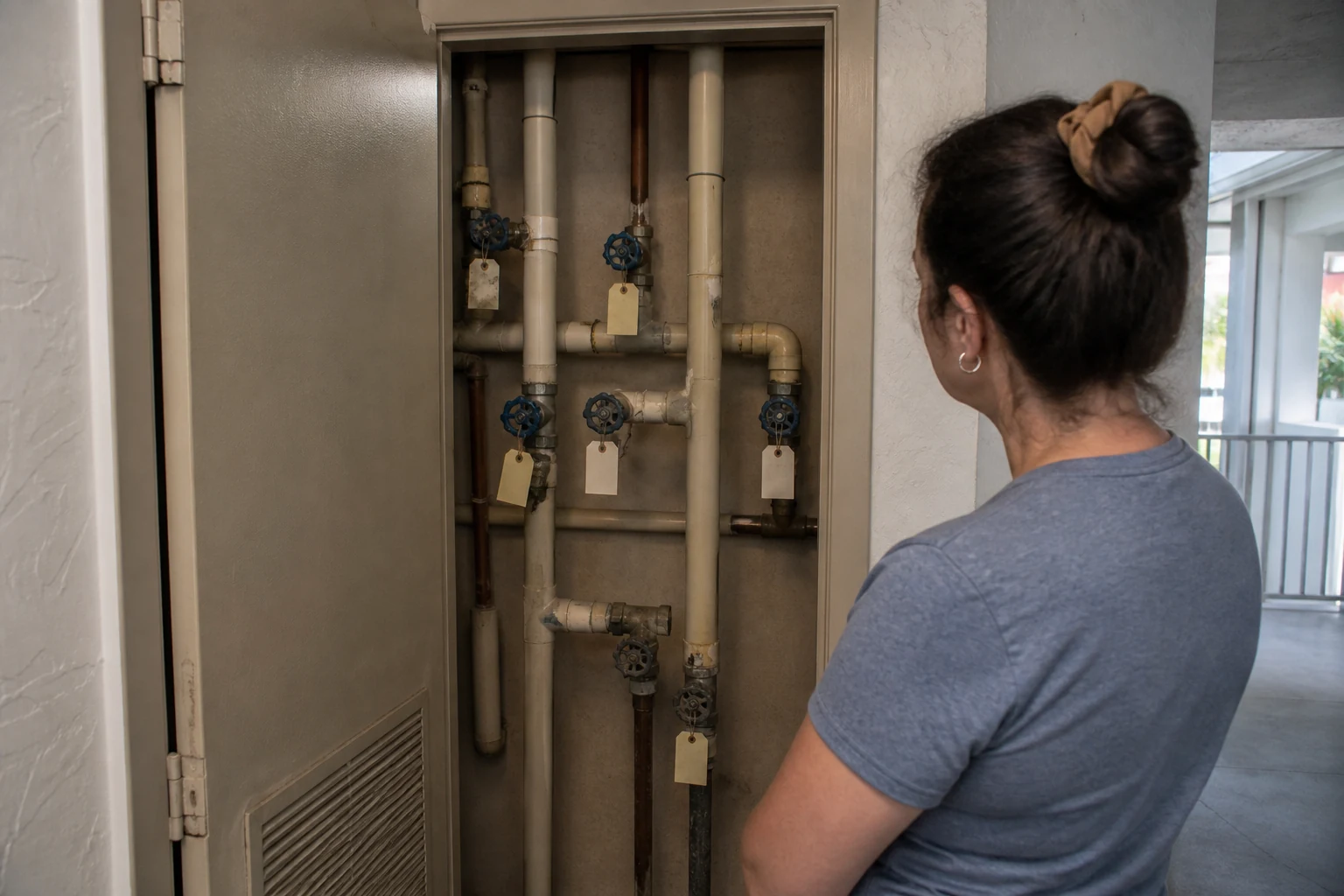
Stop when a confirmed private valve is corroded, buried, inaccessible, missing a handle, leaking around the stem or body, or unwilling to move with ordinary hand pressure. Do not add a pipe, wrench, hammer, lubricant, heat, or repeated force. A broken valve can turn a controlled leak into a larger uncontrolled release. Ask a qualified plumber for a written assessment of the shutoff, access, replacement scope, restoration impact, and any permit question. If water cannot be controlled and the utility boundary is involved, call the serving water provider.
- Photograph the valve and wider location without touching a hazardous area.
- Report whether the leak is before or after the private shutoff if that is already known.
- Ask how water will be controlled while the private valve is repaired or replaced.
- Update the household record after the work and keep the old location note only if it remains accurate.
Create a household shutoff record that another person can use
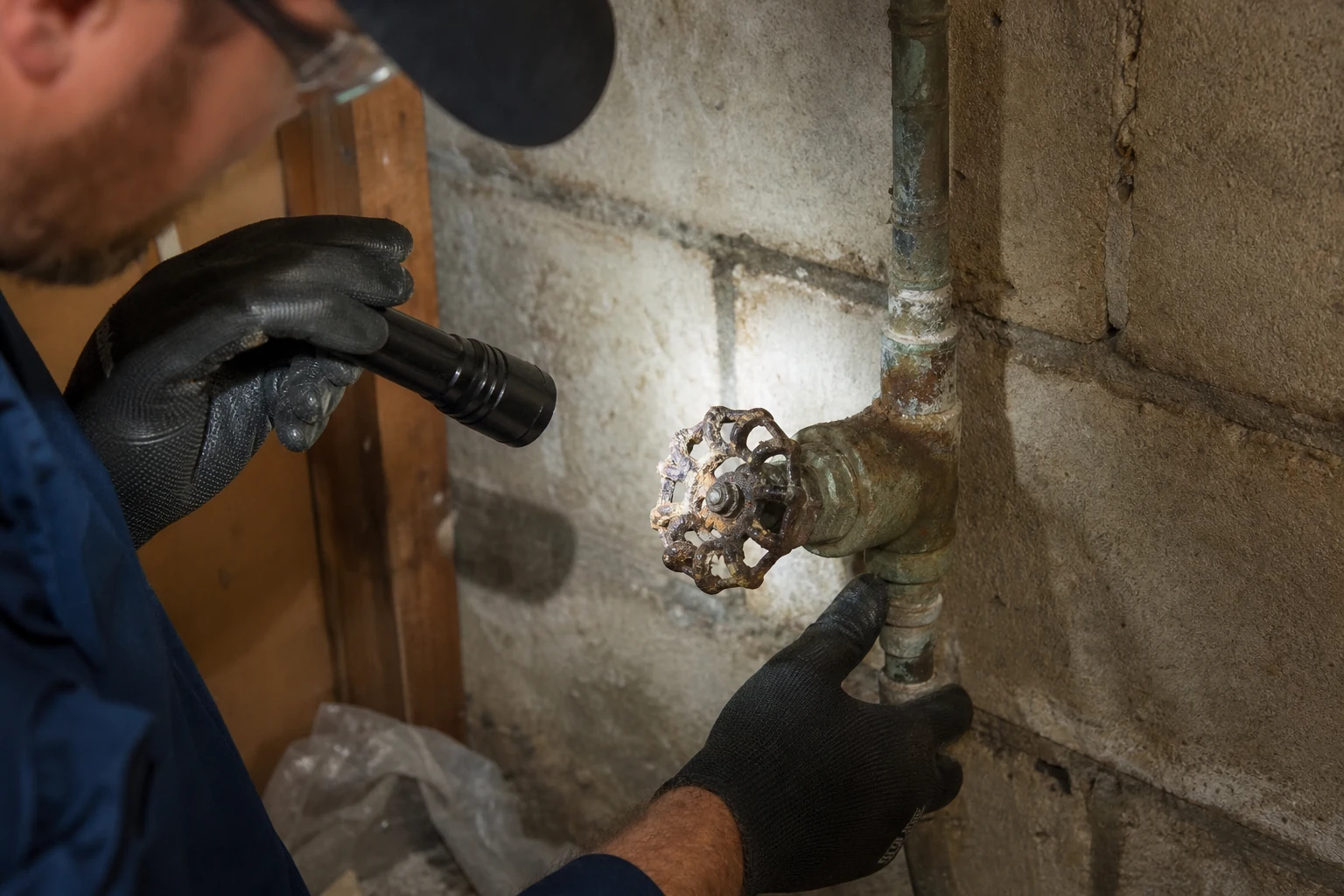
The printable version provides a blank record. Keep only the information needed to identify the control and call the right boundary—never passwords or access codes.
Record the controls
- Kitchen, toilet, laundry, water heater, irrigation, and other useful fixture valves
- Confirmed private whole-home or unit shutoff
- Private-well plumbing and professional contact if applicable
- Controls that are shared, utility-owned, fire-system related, unknown, or explicitly off limits
Record the route
- Plain-language location and access path
- Wide and close photographs
- Required key or building contact without writing access codes
- Obstacles, lighting, drainage, or mobility limitations to correct
Record the contacts
- Serving water provider and emergency number
- Association, property manager, landlord, or building emergency contact
- Qualified plumber or well professional
- Date the control and record were last confirmed
Review the shutoff plan when the property changes
A useful record is maintained without repeatedly operating a questionable valve. Use each trigger to confirm access, responsibility, contacts, and documentation.
At move-in or a change of occupant
Identify the serving provider and building contact, have the private boundary confirmed, photograph the route, and show occupants the written plan.
Before hurricane season or during an annual safety review
Check that the route is visible, dry, unlocked, illuminated, and free of storage or landscaping. Refresh contacts and arrange service if corrosion, leakage, or uncertainty is visible.
After plumbing, irrigation, renovation, meter, or well work
Confirm whether a valve, route, label, ownership boundary, or emergency procedure changed and replace outdated photographs or notes.
After an association, landlord, property-manager, or access change
Confirm the current after-hours contact and who can enter shared or locked service areas. Do not place access codes on the record.
After any shutoff use, leak, or failed attempt
Record what was operated and what happened, arrange qualified evaluation of any sticking or leakage, and update the plan only after the correct control is reconfirmed.
Use the authority that actually serves the property
A Tampa mailing address does not always mean City of Tampa water service. Confirm the provider on the utility bill or official service record.
Swipe sideways to see every column| Situation | Starting point | What to ask |
|---|---|---|
| City of Tampa water customer | City of Tampa Water Department FAQ | Confirm the private shutoff location and when the City must operate its curb stop |
| City of Tampa water emergency | City emergency phone numbers | Current water-emergency route; the City lists 813-274-8811, option 1, at review time |
| Another Tampa Bay water provider | Serving utility shown on the bill or official property record | Its emergency number, ownership boundary, meter policy, and available shutoff assistance |
| Condo, rental, or shared building | Association, property manager, landlord, or building emergency contact | Which valve serves the unit, what is shared, who can access controls, and the after-hours procedure |
| Private well | Qualified well professional and current public-health guidance | Which plumbing and electrical controls apply and what conditions make access unsafe |
Phone numbers, service boundaries, and policies can change. Confirm the current provider and instructions before relying on a saved record.
Quick answers to common shutoff questions
Swipe sideways to see every column| Question | Short answer | Best next step |
|---|---|---|
| Should I close the whole house for one leaking toilet? | Usually not if its known fixture valve safely stops the flow | Isolate the fixture, then arrange repair |
| Is the valve in the meter box mine? | Do not assume so | Contact the serving water provider; City of Tampa treats its curb stop as City property |
| Can I use a wrench on a stuck private valve? | No | Stop and arrange qualified assessment before it breaks or leaks |
| What if I cannot find a private main? | Do not guess | Ask a plumber, building contact, well professional, or serving utility to identify the correct boundary |
| Should I test the valve during a leak? | An emergency is not the time for a first test | Confirm and maintain it on a normal day |
| Will a smart shutoff replace the manual plan? | No | Treat monitoring or automation as an additional layer and keep a known accessible manual boundary |
Related next steps
Use the guide that matches the situation.
How this resource was made
Methodology and limits
This resource was reviewed against current City of Tampa Water Department guidance, City emergency contacts, and EPA WaterSense leak-prevention information on August 27, 2026. It separates private plumbing, utility property, shared-building controls, and private-well systems because the correct action depends on who owns and operates each part.
- Valve location, type, ownership, and access vary by property; photographs and general location clues cannot confirm a specific valve.
- Utility rules and emergency contacts vary across Tampa Bay. Use the actual serving water provider for the property.
- This guide does not instruct anyone to enter a meter box, operate a curb stop, service a well, disable a fire system, or repair a valve.
- Smart flow monitors and automatic shutoffs can help some households, but selection and installation are property-specific and do not replace an accessible manual plan.
Sources
Reviewed sources
- Water Department Frequently Asked QuestionsCity of Tampa Water Department · Reviewed 8/27/2026
- Check for LeaksCity of Tampa Water Department · Reviewed 8/27/2026
- Emergency Phone NumbersCity of Tampa Emergency Management · Reviewed 8/27/2026
- Home Maintenance: LeaksU.S. Environmental Protection Agency · Reviewed 8/17/2026
- Leak Detection and Flow Monitoring DevicesU.S. Environmental Protection Agency · Reviewed 8/27/2026
- City of TampaCity of Tampa · Reviewed 8/17/2026
Reviewed by Plumbers in Tampa Bay on 8/27/2026.